

How Does Color Changing Foundation Work:
The Science Behind the Magic
It is not a gimmick. It is applied chemistry. Here is what is actually happening when your foundation finds your shade.
The first time you see a color changing foundation shift from pale beige to your actual skin tone, it looks like a magic trick. It is not magic. It is pH chemistry, polymer science, and careful formulation working together. Understanding how it works makes you a much better judge of which products are doing the real thing and which are just using the term to sell a slightly warm-tinted base.
This article breaks down the actual science: what microencapsulation is, how skin pH triggers pigment release, why some formulas oxidize and others do not, and what happens at the molecular level in those crucial 90 seconds after you apply adaptive foundation to your face.
Your Skin Is a Chemical Environment
Before the foundation, the skin. Your skin's surface is not neutral. It maintains what is called the acid mantle, a slightly acidic film formed by sebaceous secretions, sweat, and the natural breakdown of dead skin cells. The pH of this film typically falls between 4.5 and 6.2, though this varies significantly between individuals.
This is not a trivial difference. A skin pH of 4.8 is meaningfully more acidic than a skin pH of 6.0. The acid mantle composition also varies by skin type (oily skin tends to be slightly more acidic, dry skin slightly less), by the area of the face (the T-zone, cheeks, and jawline can all differ), and by factors like recent cleansing, hormonal state, and diet.
This chemical variation is what makes shade matching with traditional fixed-pigment formulas so unreliable. Your skin chemistry is not static. Any product that assigns you a fixed shade code is pretending the variable is constant when it is not.
The acid mantle is your skin's first line of defense. It inhibits bacteria, maintains the skin barrier, and regulates moisture loss. Its pH also determines how cosmetic ingredients interact with your skin. A disrupted acid mantle (from aggressive cleansing, over-exfoliation, or high-pH products) can make adaptive foundation pigments react differently. Healthy, well-moisturized skin gives better results with adaptive formulas.
What Microencapsulation Actually Is
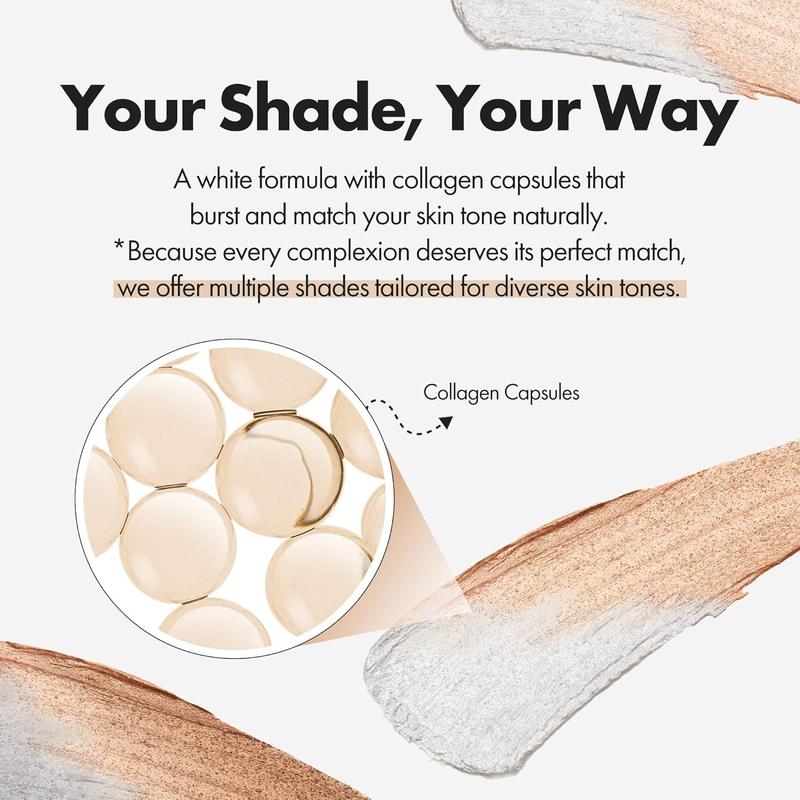
Microencapsulation is a process in which small amounts of an active ingredient (in this case, pigment) are coated in a thin polymer shell to create microscopic capsules. These capsules protect the pigment from the external environment until a specific trigger causes the shell to break down or become permeable.
The technology is used in pharmaceuticals (time-release medications use the same principle), food science (flavor capsules in carbonated drinks), and increasingly in cosmetics. In a color-adaptive foundation, the polymer shells are designed to respond to the specific pH conditions found on your skin.
Here is what happens step by step:
In the formula, pigment is locked inside
Before application, the encapsulated pigments sit inside their polymer shells. The base color of the formula (typically a neutral beige) is the color you see in the packaging. This is not the final adapted color.
Contact with skin triggers pH shift
When the formula contacts your skin surface, the acid mantle environment begins to interact with the polymer shells. The shells are engineered to become permeable at specific pH levels corresponding to the normal skin range of 4.5 to 6.2.
Pigment releases proportionally
As the shell becomes permeable, the encapsulated pigment releases gradually. The rate and extent of release depends on the specific pH of your skin. More acidic skin releases pigment differently than more alkaline skin, which is what creates the adaptive color effect.
Color settles to your specific match
Within 60 to 120 seconds, the released pigment has blended with your skin's undertones. The result is a color that has emerged from the reaction between the formula and your specific skin chemistry, not a fixed shade applied over it.
pH-Responsive Pigments in a Stick Format
The Lindalia foundation stick uses genuine microencapsulated adaptive pigments, not thermochromic dyes. The chemistry you just read about, in a two-minute morning routine.
See the ProductThermochromic Pigments vs. pH-Responsive Pigments
This distinction matters enormously when you are evaluating products. Thermochromic pigments change color in response to temperature. Your face has a surface temperature of roughly 32 to 34 degrees Celsius. All faces are approximately the same temperature, so a thermochromic foundation shifts color by approximately the same amount for everyone.
This means thermochromic foundations do not actually adapt to individual skin. They shift slightly warmer on skin contact (because the product warms from room temperature to body temperature), but that shift is essentially the same for every person who applies them. You get a marginal color change, not a personalized match.
pH-responsive microencapsulated pigments work differently. Because individual skin pH varies meaningfully between people (and even between areas of the same person's face), the pigment release is genuinely individualized. This is why a well-formulated adaptive foundation can look different on two people applying it from the same tube.
If a "color changing" foundation's marketing says it adapts to your skin temperature, or shows the before/after as simply "lighter in packaging, darker on skin," it is likely thermochromic. Ask specifically: does it respond to skin pH? If the brand cannot answer that question, assume thermochromic. pH-responsive is the more sophisticated and more genuinely adaptive technology.
Why Oxidation Happens and How Encapsulation Prevents It
Foundation oxidation (the orange-shift that happens during the day) is caused by iron oxide pigments in the formula reacting with oxygen and the natural oils on your skin. This is a chemical reaction, not a smudge or transfer problem. It happens inside the formula itself, and it happens to almost everyone who wears traditional foundation, to varying degrees.
When pigments are encapsulated in polymer shells, they are physically separated from the oxygen and oil environment on your skin until the shell releases them during the controlled activation process. Once released and adapted, properly stabilized encapsulated pigments are less prone to further oxidation because the reactive surface of the pigment has already engaged with the skin chemistry in a controlled way.
This is why high-quality adaptive foundations consistently outperform traditional formulas on the oxidation test. It is not a separate feature. It is a natural consequence of the encapsulation technology itself.
What Happens to the Polymer Shell
A reasonable question: if the polymer shells break down during activation, what happens to them? In well-formulated adaptive foundations, the polymer shell material is either biodegradable (breaks into inert compounds that wash off with water) or is resorbed as part of the formula's emollient base. Neither outcome presents a skin concern at cosmetic use concentrations, and both are assessed as part of standard cosmetic ingredient safety evaluation.
Some concerns have been raised about microplastics in cosmetics generally. Adaptive foundation polymer shells are typically made from biopolymers (plant-derived) or from materials that break down fully in water, which distinguishes them from persistent microplastic particles. If this is a concern for you, it is worth reading the specific ingredient declarations and looking for brands that explicitly address this in their formulation notes.
"When your foundation adapts to your skin's pH, it is not reading your undertone with a digital sensor. It is doing something more interesting: responding to your body's chemistry the way a skincare formula does."
The Skincare Ingredients Layer
The same emollient and carrier base that delivers encapsulated pigments can also carry skincare actives. In a well-constructed adaptive foundation, niacinamide (vitamin B3) is particularly well-suited because it is stable in the same pH range that activates the adaptive pigments. Niacinamide at 2-5% concentration has documented effects on skin tone evenness, pore appearance, and barrier function over time.
Collagen in a topical formula does not penetrate deeply (the molecule is too large for transdermal absorption), but it functions as a film-forming agent on the skin surface. This film helps the foundation sit smoothly over fine lines and texture rather than settling into them, which is why collagen-containing formulas often look noticeably smoother in wear.
When you are evaluating an adaptive foundation for skincare value, the question is not just whether these ingredients are listed. It is where they appear in the ingredient list (early means higher concentration) and whether the pH of the overall formula is compatible with their activity. Niacinamide, for instance, becomes less effective above pH 7, and the best adaptive foundation formulas are designed to sit well within the active range.

See It in Action
Encapsulated pigments. Niacinamide and collagen. Integrated brush. Satin finish that does not turn orange by noon.
See the ProductWhy This Matters for Seasonal Skin Changes
Most people with foundation in their collection have at least two versions: a "summer shade" and a "winter shade." This is not vanity. It is a genuine practical response to the fact that sun exposure changes melanin distribution and skin depth significantly over the course of a year, and traditional foundations cannot accommodate this without a separate purchase.
Because adaptive foundation responds to your current skin chemistry rather than a fixed decision you made in a store six months ago, it tracks seasonal changes automatically. The same formula that matched your winter skin in January will still match your July skin, because the pigment activation is happening in response to what your skin is today, not what it was when you bought the product.
This is one of the most practically useful properties of adaptive foundation, and it is one that rarely gets discussed in the marketing. The science behind the pH-responsive mechanism is what makes this possible. The product adapts because it reads your skin each time, not because it was pre-programmed to cover a specific shade range.
With genuine pH-responsive adaptive foundation, you do not need a summer shade and a winter shade. The same formula adapts to where your melanin is today. Seasonal skincare adjustments (heavier moisturizer in winter, lighter in summer) can actually improve adaptive foundation performance by keeping the acid mantle in its optimal range, which supports more accurate pigment activation.

Chemistry That Works for You, Year-Round
One foundation, all seasons. No re-buying, no guessing. Just the right color every morning because the formula reads your skin every time.
See the Product