

Face Brush for Lymphatic Drainage:
Morning vs Evening, When to Use It
The timing of your lymphatic brush session changes everything. Morning and evening sessions serve completely different biological purposes, and knowing the difference doubles your results.
Most people use their lymphatic drainage face brush once, feel a difference, and keep doing it whenever they remember. That works fine. But when you understand what your lymphatic system is actually doing at different points in the day, you can align your practice with your biology rather than working against it.
Morning and evening are not interchangeable windows. They each address a specific physiological state, and a five-minute session becomes noticeably more effective when timed correctly.
"Your lymphatic system is most congested at wake-up and most available for maintenance work in the evening. Two different problems, two different goals, one tool."
Why Timing Actually Matters for Lymphatic Drainage
The lymphatic system has no pump. Unlike blood, which the heart circulates continuously, lymph fluid moves through a combination of muscle contractions, breathing, gravity, and external pressure. When you sleep horizontally for seven or eight hours without significant movement, lymph fluid redistributes and pools, especially around the face, eyes, and jaw.
By the time you wake up, that fluid has been sitting largely still for hours. This is why morning puffiness is not imaginary: it is a predictable fluid accumulation pattern tied directly to posture and reduced lymphatic activity during sleep.
By evening, your lymphatic system has been running all day. Gravity has helped drain a portion of the accumulated fluid. But over the course of the day, new stressors accumulate: sodium from meals, fatigue-related tension in the jaw and neck muscles, and the general burden of environmental exposure. The lymph nodes in your neck and behind your ears may be sluggish from a day of processing rather than primed for drainage.
These two states call for different approaches, even though the tool and the technique remain the same.
The Morning Session: De-Puff and Prepare
Morning brushing is arguably the most immediately visible session. You are starting from maximum congestion and working toward a baseline your face should have been at all along. Results show up fast, within the same five-minute window.
What You Are Solving at 7am
Horizontal sleep plus eight hours of minimal lymph movement equals pooled fluid in the soft tissue around the eyes, cheeks, and along the jawline. The effect is worse if you slept on your side, ate late the night before, or had alcohol. It is also more pronounced over 35, when lymphatic vessel wall tone naturally decreases.
Morning brushing addresses this directly. You are mechanically stimulating lymphatic capillaries at precisely the right depth (0.1 to 0.2 millimeters below the skin surface) to encourage the pooled fluid to begin moving toward the lymph nodes clustered in the neck, behind the ears, and under the jaw.
The Morning Sequence
- Neck first, always Five slow strokes down each side of the neck, from under the ear to the collarbone. This opens the drainage pathway before you move fluid from the face. Without this step, you are pushing fluid toward a closed gate.
- Under-eye crescent strokes The area from the inner corner of the eye outward toward the temple. This is where overnight fluid accumulates most visibly. Use the lightest possible touch here since the skin is thinnest.
- Cheek sweeps outward and down From the nose outward toward the ear, then angling slightly down toward the jaw. Follow the natural drainage direction toward the neck nodes.
- Jawline toward ear, then down neck The jawline defines your face architecture. Sweep from chin outward toward the ear in three to four strokes. Always finish with another pass down the neck to complete the circuit.
- Forehead downward toward temples Light downward strokes from the hairline to the brow, angling toward the temple. Fluid there drains to the preauricular nodes just in front of the ears.
Total morning time: four to six minutes. You will likely notice visible change immediately. After two to three weeks of consistent morning sessions, your baseline shifts and the overnight puffiness becomes genuinely less pronounced.
The Morning Skincare Bonus
Brushing before serum application does something your products cannot do for themselves: it prepares the skin to actually receive them. When lymph flow is active, the interstitial fluid in the dermis is in motion. Serums applied immediately after brushing absorb measurably better because the tissue channels are open rather than congested.
Apply your vitamin C or hyaluronic acid serum within two to three minutes of finishing your morning brush session, while the lymphatic stimulation is still active.

Start Your Morning Routine Right
Ultra-fine bristles calibrated for the exact pressure level lymphatic capillaries respond to. Five minutes, dry skin, visible change.
See the ProductThe Evening Session: Release Tension, Drain the Day
Evening brushing is less dramatic in its immediate visual results and far more underrated for its cumulative effect. By evening, your face has accumulated a different kind of burden: not just overnight fluid, but daily tension, jaw clenching, environmental debris, and the lymph load from whatever your immune system processed during the day.
What You Are Solving at 10pm
Facial muscles, particularly around the jaw, temples, and forehead, hold tension most people do not realize they have accumulated. This tension restricts superficial lymph flow by compressing the soft tissue channels lymph moves through. A person who grinds their teeth during the day or clenches their jaw while concentrating will have significantly reduced lymphatic drainage in the lower face by evening.
Evening brushing addresses this in two ways simultaneously. The physical stimulation encourages fluid movement. The ritual itself (slow, intentional, five minutes of directed touch) signals the nervous system to downregulate muscle tension before sleep.
The Evening Sequence
- Neck and collarbone first Longer, slower strokes than morning. Three to four passes down each side of the neck, then across the collarbone area. You are not in a rush. Let the strokes be deliberate.
- Jaw and masseter release The masseter muscle runs from the cheekbone to the jawline. Small circular strokes along this muscle's path, then outward sweeps from chin to ear. This targets the area most likely to be holding tension.
- Temple and brow drainage Gentle circular strokes at the temples (where temporal tension accumulates from screen time), then sweeping down toward the preauricular nodes.
- Full face outward sweeps Broad, slow strokes from the center of the face outward in every direction. Think of this as a reset stroke, pulling everything toward the drainage points.
- Final neck pass Close the circuit again. End with five slow strokes down each side of the neck, finishing at the collarbone. This is the completion of the drainage pathway.
The Evening Skincare Bonus
Evening brushing before your nighttime serum or moisturizer creates the same absorption advantage as morning, but with a different downstream effect. Nighttime products are largely repair and regeneration products: retinol, peptides, ceramides. When applied to a face that has just had lymphatic flow stimulated, these active ingredients encounter tissue that is in active recovery mode with open channels rather than congested ones.
Apply your evening actives within three minutes of finishing. This is when their absorption is at its best.
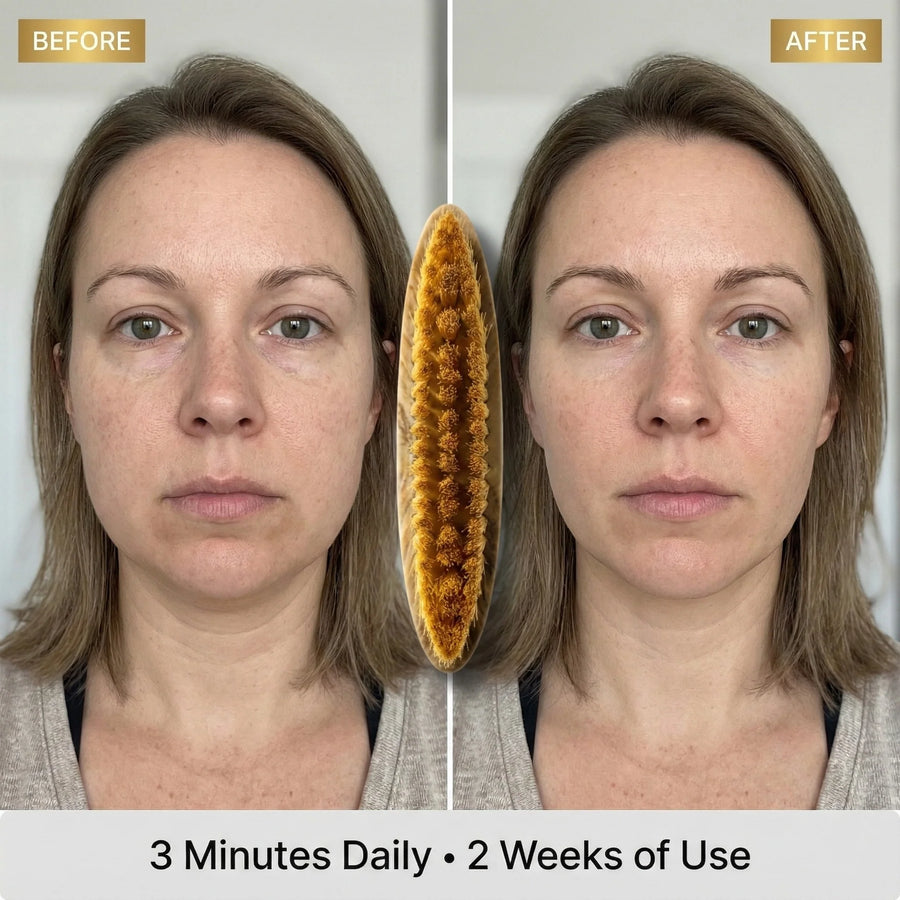
One Tool, Two Rituals
The De-Bloat Brush is designed for dry use on delicate facial skin. No oil required, no technique to master, works both morning and evening.
See the ProductMorning vs Evening: A Direct Comparison
De-Puff and Prepare
- Addresses overnight fluid accumulation
- Visible depuffing within minutes
- Prepares skin for serum absorption
- Sets face shape for the day
- Best on completely dry skin
- Pairs with vitamin C, hyaluronic acid
- Higher immediate visual payoff
Release and Restore
- Addresses accumulated daily tension
- Releases jaw and temple tightness
- Prepares skin for nighttime actives
- Supports sleep-phase tissue repair
- Can be done before or after cleansing
- Pairs with retinol, peptides, ceramides
- Higher cumulative long-term payoff
| Factor | Morning | Evening |
|---|---|---|
| Primary goal | Drain overnight fluid | Release daily tension + drain |
| Immediate visible result | High (depuffing within session) | Moderate (smoother face overall) |
| Skin state | Dry, just woken up | Dry, before or after cleansing |
| Pressure | Very light, under-eye area especially | Slightly firmer on jaw/masseter |
| Stroke speed | Moderate | Slower, more deliberate |
| Skincare pairing | Vitamin C, brightening serums | Retinol, peptides, ceramides |
| Long-term benefit | Reduced baseline puffiness | Improved facial definition + sleep quality |
If You Only Have Time for One Session
Morning wins on visible impact. The before-and-after within a single session is most pronounced in the morning simply because you are starting from the most congested state. If you want to see what the brush actually does, do it at 7am right after you wake up.
Evening wins on cumulative results. People who are consistent with evening sessions report that their morning puffiness becomes less dramatic over time. When you consistently encourage drainage before sleep, you are essentially starting the next morning's session ahead. The overnight accumulation still happens, but from a lower baseline.
The ideal is both. Morning for immediate impact, evening for long-term structural change. Five minutes each. Ten minutes total out of your day for a face that looks and functions measurably differently.
Common Timing Questions
Can I brush more than twice a day?
You can, but there is diminishing return beyond two sessions. Lymphatic capillaries benefit from stimulation, but they also need time to complete each drainage cycle. If you brush mid-afternoon and feel some facial tension from a long meeting, that is reasonable. But three or four sessions daily is not meaningfully better than two.
What if I shower in the morning? Does that reset the benefit?
No. The drainage effect persists after showering. Brush before your shower if you prefer, or after, on dry skin before applying products. The sequence that fits your existing routine is the one you will actually maintain.
Should I change technique if I brush in the evening vs morning?
Slightly. Morning: slightly more focus on the under-eye and upper cheek areas where overnight fluid is most concentrated. Evening: slightly more time on the jaw and neck, where daytime tension and lymph load accumulates. The core strokes are identical. The emphasis shifts.
Is evening brushing okay right before bed?
It is actually ideal right before bed. The tension-releasing effect, combined with the deliberate slow breathing that naturally accompanies a calm five-minute ritual, can meaningfully affect sleep quality. Several consistent users report falling asleep faster after establishing an evening brush routine, though this is anecdotal rather than a clinical claim.
Morning brushing solves a structural problem: fluid that accumulated while you were asleep. Evening brushing solves a cumulative problem: tension and load that built up while you were awake. Both sessions use the same five-minute window and the same tool. Doing both consistently is the difference between visible occasional results and a genuinely different face over time.
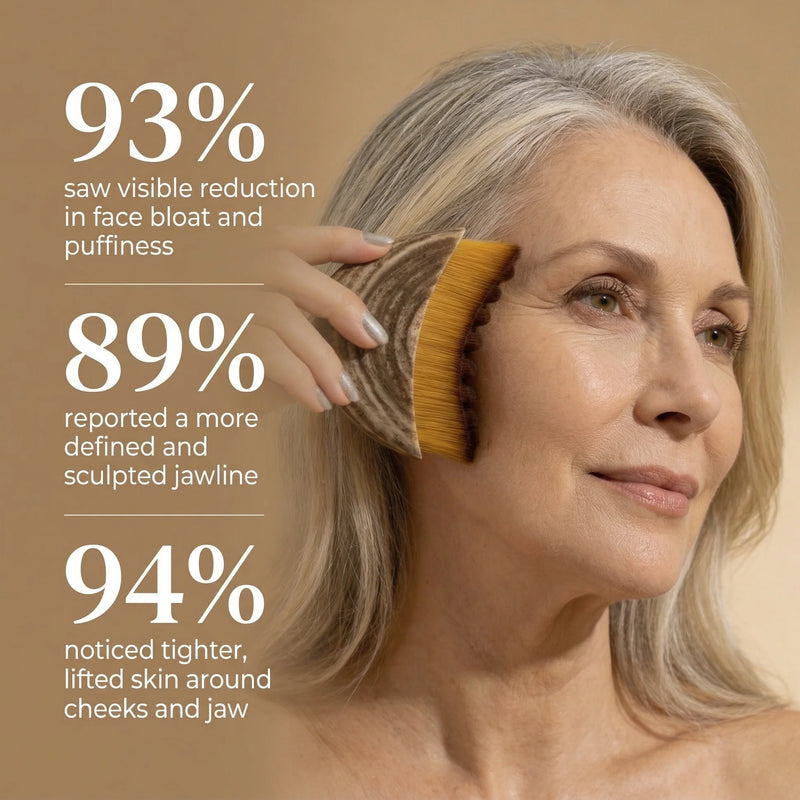
Make Both Sessions Part of Your Day
Ultra-fine bristles. Dry skin. Five minutes. Whether it is 7am or 10pm, your lymphatic system responds the same way.
See the Product