

4 in 1 Color Changing Foundation: Can One Product Really Do It All?
Primer, shade match, coverage, and skincare in a single step. Unpacking what "4 in 1" actually means, which claims hold up, and what to expect from a multi-function adaptive foundation.
The "4 in 1" label on a color changing foundation is one of the more loaded claims in modern beauty marketing. It suggests that a single product can replace primer, deliver adaptive shade matching, provide real coverage, and offer meaningful skincare benefits simultaneously. Some of those claims have more substance than others. This article works through each function to tell you which ones actually hold up in practice and what the honest trade-offs look like.
What "4 in 1" Usually Means
The four functions claimed by most 4-in-1 color changing foundations follow a consistent pattern across the category. Some products count them differently but the underlying claims are usually the same: primer, shade adaptation, coverage, and skin treatment.
Before getting into each one, it is worth naming the structural tension in multi-function products. Every function added to a formula is a variable that needs to be balanced against the others. A product that genuinely delivers five strong functions is formidably complex to make. Most 4-in-1 products deliver two or three functions well and the others at a more modest level. Knowing which ones are the priority helps you decide if the trade-off works for your routine.
No single product replaces a dedicated primer, a specialized serum, and a full-coverage foundation simultaneously. What good 4-in-1 foundations do is meaningfully reduce the number of steps needed for an everyday, real-life result. That is genuinely valuable, but it is a different claim.
Function 1: Primer
The primer function in a color changing foundation refers to the product's ability to prepare the skin surface for coverage application, smooth texture, and improve wear time. This typically comes from silicone-based or polymer-based ingredients that fill fine lines and pores at the surface level and create a receptive layer for the coverage above.
In stick format color changing foundations, this function is often delivered through the emollient base of the formula itself. As the stick glides across the skin, the waxy or creamy base warms slightly and creates a smoothing layer before the pigment activates. This is a genuine primer-like effect, though not as deep-pore-filling as a dedicated silicone primer.
The degree to which the primer function reduces the need for a separate primer step depends heavily on your skin type and the specific concerns you are trying to address. For pore minimization on oily skin, a dedicated primer still has the edge. For general smoothing on normal to combination skin, a good 4-in-1 foundation often does enough.
Function 2: Adaptive Shade Matching
This is the category-defining function and the one that requires the most nuanced understanding. As covered throughout the broader color changing foundation discussion, the quality of shade adaptation depends almost entirely on the mechanism being used.
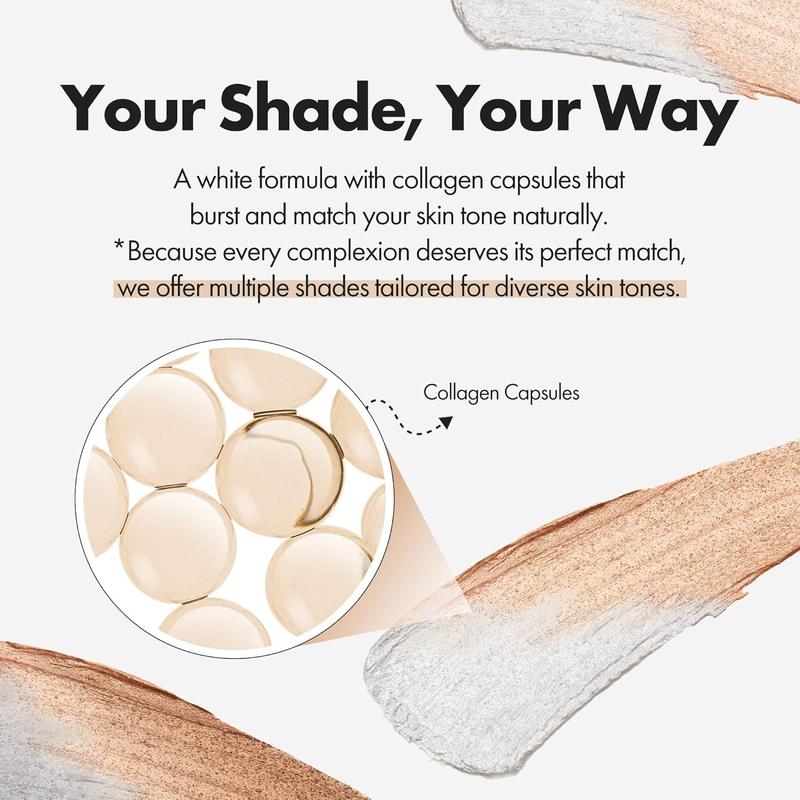
Thermochromic systems (responding to skin temperature) produce a directional shift that is real but limited in range. pH-responsive microencapsulation (responding to the acid mantle of skin) produces a shift that is more personalized and correlates more closely with undertone and natural pigmentation.
A 4-in-1 that uses pH-responsive encapsulation delivers meaningful adaptive shade matching. One that uses only thermochromic pigments delivers a more modest shift that will work well for complexions already close to the base shade.
This is the function that most differentiates quality levels in the category. It is worth researching which mechanism a specific product uses before assuming the shade adaptation will be precise.

Lindalia's Stick: Adaptive Shade + Niacinamide + Collagen
pH-responsive microencapsulation for genuine shade adaptation, niacinamide for tone and pore refinement, collagen for surface smoothing, and a stick format that applies its own primer layer in one step.
Shop LindaliaFunction 3: Coverage
Coverage in a 4-in-1 color changing foundation is generally in the light to medium range. This is partly a formulation reality: building higher coverage into a formula with active adaptation mechanisms, skin-conditioning actives, and primer properties requires balancing a complex set of ingredients, and heavy coverage tends to work against the other goals.
Light to medium buildable coverage is the sweet spot for most everyday use cases anyway. It allows the skin to show through where you want a natural look and can be concentrated in areas where more coverage is needed. For full-coverage needs, a dedicated foundation is still the right tool.
The key coverage-related quality to look for in a 4-in-1 formula is consistency: does the coverage look even 30 minutes after application, or does it separate and look patchy? This depends on the emollient and film-forming ingredient quality in the formula, which varies significantly between products.
Function 4: Skin Treatment
This is the function that varies most widely between 4-in-1 products and the one where marketing often outpaces reality. Skin treatment in a foundation context refers to active ingredients that provide ongoing benefit to the skin while the foundation is worn.
The most commonly included actives are niacinamide (tone evenness, pore minimization), hyaluronic acid (surface hydration), panthenol (barrier support and soothing), and collagen or collagen peptides (surface film-forming, fine line smoothing).
The effectiveness of these ingredients in a foundation formula depends on their concentration and on how long the product actually sits on the skin in contact with active layers. Foundations that are applied and then immediately covered by powder or setting spray deliver less active benefit than those worn as the top layer throughout the day. For the skincare function to be meaningful, the product needs adequate concentrations and contact time.
Niacinamide
Regulates sebum, minimizes pore appearance, evens skin tone over time. Effective at concentrations of 2% and above. Check where it falls on the ingredient list.
Collagen
At the molecular weight used in cosmetics, collagen forms a film on the surface that temporarily smooths fine lines and adds a plump appearance. Not the same as deep skin regeneration, but visually meaningful.
Hyaluronic Acid
Draws water to the surface layer of the skin, improving hydration appearance. Works best in humid environments or over a moisturizer. Less effective in very dry air without a hydrating base.
Panthenol
A form of vitamin B5 that supports the skin barrier, soothes irritation, and improves moisture retention. A strong supporting active in sensitive or reactive skin formulas.
"The best 4-in-1 foundations do not replace every step. They collapse your routine into fewer steps without losing the results that matter most in your daily context."

Lindalia's Color Changing Stick: The Ingredients That Make It Work
pH-responsive pigments, niacinamide for daily pore and tone benefit, collagen for fine line smoothing, and an application format that delivers all four functions in a single stroke.
Learn MoreWhen a 4 in 1 Actually Works for Your Routine
A 4-in-1 color changing foundation works best in three real-life contexts.
Everyday minimal makeup routines. If your goal is a quick, polished look without a long preparation sequence, a well-formulated 4-in-1 delivers a genuinely useful shortcut. Moisturizer, 4-in-1 foundation, done. This is where the multi-function format earns its name.
Travel and compact routines. One product instead of four — fewer things to carry, fewer liquids for airline restrictions, faster application when you are not at home. A stick format especially wins here because it has no spillage risk and applies without tools.
Makeup minimalists. If you do not enjoy a multi-step routine and prefer your skin to show through your coverage, the 4-in-1 approach provides structure without weight. The adaptive shade function removes the shade-matching anxiety that often comes with going foundation-light.
Where it works less well: specialized skin concerns that need dedicated actives, high-coverage needs, very dry or very oily skin without additional management steps, or situations where you need your look to last more than six to eight hours without touch-ups.
Choosing the Right 4 in 1 Color Changing Foundation
The checklist that actually matters when comparing products:
What is the adaptation mechanism? Temperature or skin chemistry? The answer affects how well it matches your specific undertone rather than just shifting in a general direction.
Are the active ingredients at useful concentrations? Check where niacinamide and other actives appear in the ingredient list. Ingredients listed toward the end of the list are present at very low concentrations.
What is the texture and application format? Stick formats tend to provide more control and less product transfer; liquid or cream formulas offer more seamless blending but require a tool or careful finger application.
What is the finish? Satin and natural finishes are most versatile. Fully matte 4-in-1 formulas can look dry, particularly on mature or dry skin. High-glow finishes may need management on oily skin.
Lindalia: Primer, Shade Match, Coverage, and Skin Treatment in One Stick
Designed for the routine that doesn't need ten steps. pH-responsive color adaptation, skin-conditioning actives, and buildable natural coverage in a single travel-ready stick.
Shop the StickA good 4-in-1 color changing foundation is one of the more genuinely useful innovations in the modern makeup category. It does not replace every specialized product, but it earns its name by meaningfully simplifying a daily routine without sacrificing results that matter. The key is choosing one where the adaptation mechanism and active ingredient quality match what you actually need.